Interleaving practice for children: why mixing activities can help
When children practice one kind of problem or activity repeatedly, it can feel smooth. Mixing related types is often harder in the moment—but research suggests that the extra decision-making can help learners recognize what to do later.
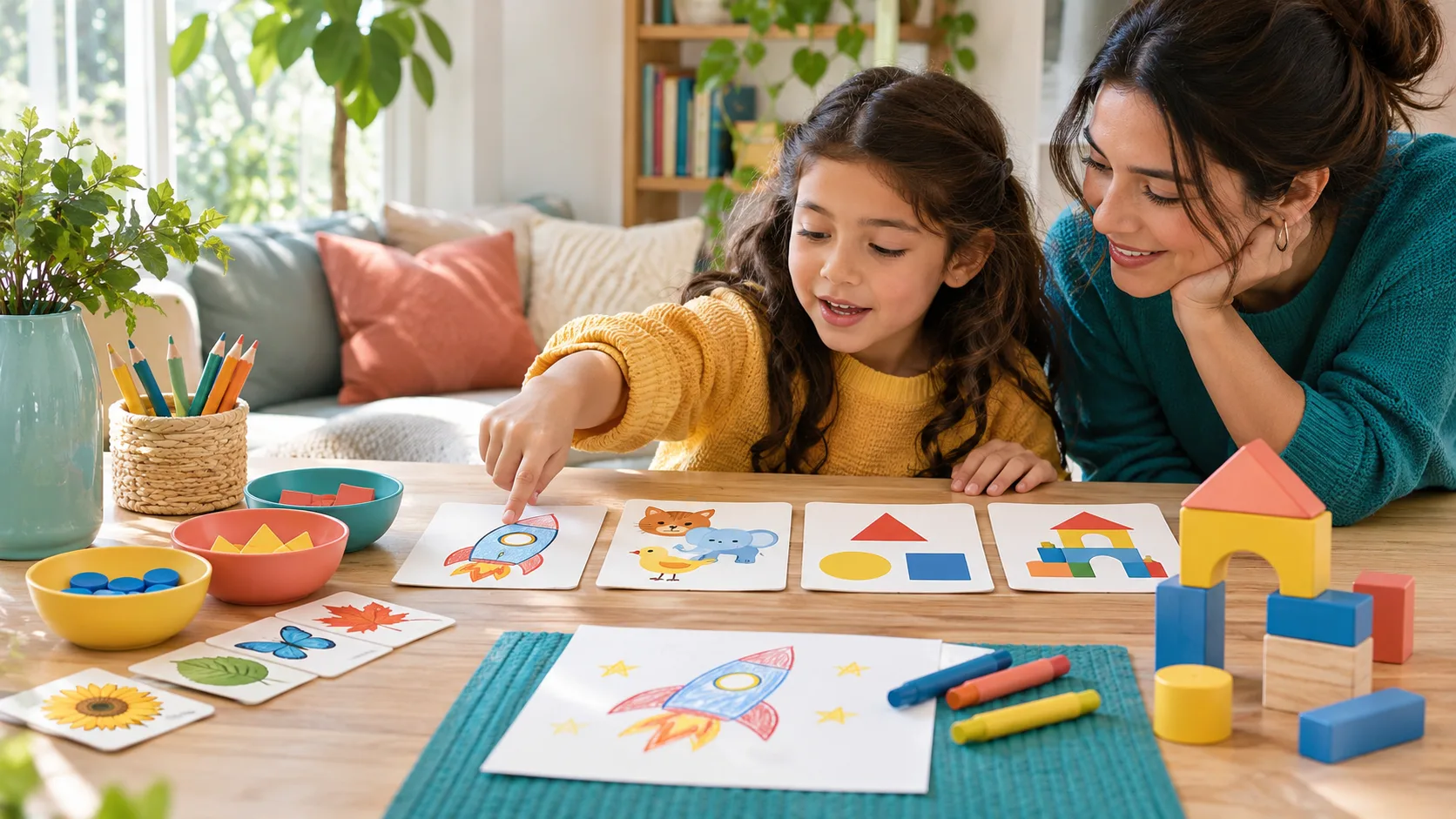
The practical idea: mix a few related activities instead of completing a large block of only one type, while keeping the choices small enough to feel manageable.
What is interleaving?
Interleaving means alternating between related skills, categories, or problem types. A blocked sequence might look like A A A, then B B B, then C C C. An interleaved sequence might look like A B C A C B.
Interleaving is not random chaos. The activities should be related enough that the child can compare them and learn when each one fits.
What the research found
Taylor and Rohrer studied children practicing four kinds of mathematics problems. Interleaved practice made the practice session feel less fluent, but the children’s scores on a test one day later were about twice as high as the blocked group’s scores in that experiment.
Read the research article: The Effects of Interleaved Practice.
A later classroom study also examined interleaved mathematics practice in regular school settings and reported improved test performance when practice problems were distributed and mixed rather than kept in large same-type blocks.
Read the Journal of Educational Psychology study.
Why it can feel harder
When the next activity changes, the child has to identify the task and choose a strategy again. That can make the work look slower or less fluent. A harder practice session is not automatically better, but temporary effort is one reason interleaving can reveal whether a learner can recognize the right approach.
How parents can use it without making homework harder
Mix two or three familiar activities
Start with things your child already knows. For example, alternate a color pattern, a picture story, and a sorting task. The child practices noticing which kind of thinking fits.
Use a visible choice tray
Place three small activities in front of the child. Invite them to choose the order, or use a simple A–B–C pattern. Keep the session short and end before the choices become overwhelming.
Talk about the choice
Ask “How did you know what to do here?” The explanation helps the child notice differences between tasks instead of only completing steps.
A 15-minute mixed-learning plan
- Five minutes: make a pattern with colors or shapes.
- Five minutes: switch to a picture or coloring prompt and tell what happens next.
- Five minutes: build, sort, or solve a small challenge using a different rule.
For a younger child, interleaving may simply mean changing the type of play before returning to the first idea another day.
Connect it to coloring
Instead of coloring three nearly identical pages in a row, choose pages with related but different thinking: notice an animal’s features, compare two habitats, then invent a story. MyColor.fun can supply the visual prompts; your questions help the child compare and choose.
What the evidence does not say
Interleaving is not best for every first introduction, every child, or every skill. If a child is still learning the basic action, a short blocked demonstration may be helpful first. Then mix familiar examples gradually. The goal is flexible recognition, not unnecessary difficulty.
Build a varied activity set
Use the finder to choose a few activities that fit your child’s age and the time you have.
Open activity finder