The spacing effect for children: how to practice without cramming
If a child forgets something between practice sessions, that does not always mean the practice failed. Research on the spacing effect suggests that revisiting learning after a little time has passed can support longer-term retention better than doing every repetition back-to-back.
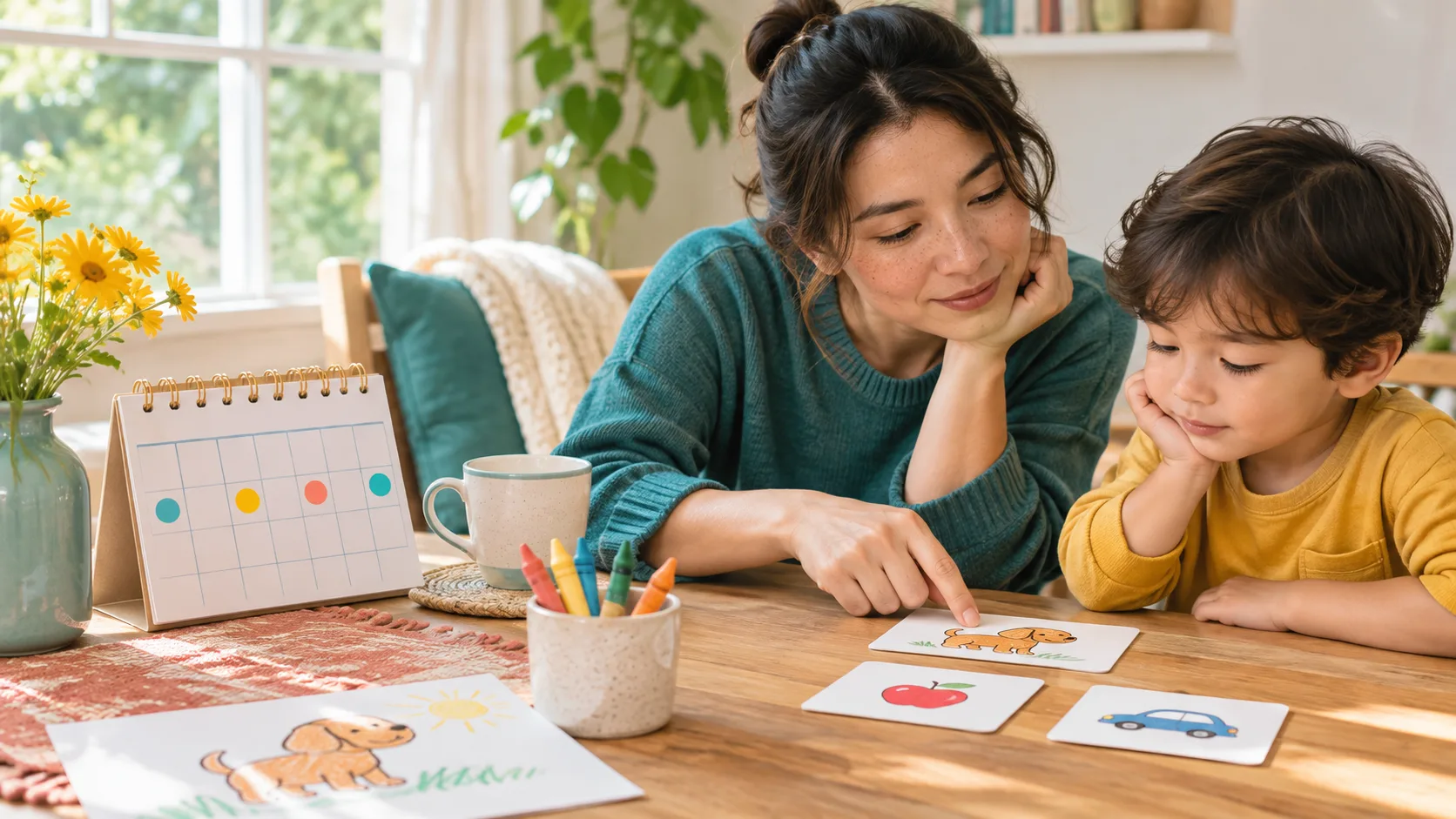
The practical idea: return to the same skill briefly across several days. Keep it playful, ask the child to remember before showing the answer, and stop while the activity still feels manageable.
What is the spacing effect?
The spacing effect is the finding that learning episodes separated by time can produce better later memory than the same amount of practice packed into one sitting. The comparison is usually called spaced or distributed practice versus massed practice.
This does not mean that every long gap is best, or that a child should be left confused. The useful interval depends on the learner, the material, and how long you want the learning to last.
What the research actually found
A large review of distributed practice
Cepeda and colleagues reviewed 839 assessments from 317 experiments. Their analysis found that the best gap between learning episodes depends partly on how long the learner needs to remember the material: longer desired retention generally calls for a longer interval between reviews.
Read the 2006 meta-analysis in PubMed: Distributed Practice in Verbal Recall Tasks.
Research with children
In a study of preschool children, Vlach and Sandhofer examined memory and category learning when examples were presented together or separated. The paper is useful because it looked beyond repeating the exact same item and considered how children learn categories.
In another study, children ages 5–7 learned science concepts through lessons delivered on different schedules. Children who experienced the lessons across four consecutive days were better able to generalize the principle to a new example than children who received the lessons in one day.
Read the Child Development study: Distributing Learning Over Time.
For older elementary learners, a study of Grade 3 and 4 children found that spaced exposure improved recognition of novel written words compared with massed exposure, although the effect was not identical for every outcome: spelling recall did not show the same benefit in that experiment.
Read the study in PubMed: The Effects of Spacing and Massing on Children’s Orthographic Learning.
What this means for parents
The research supports a modest claim: revisiting a skill over time is worth trying when you want the learning to last. It does not prove that a specific coloring page, schedule, or number of minutes will work for every child. Treat spacing as a design choice, not a performance test.
A gentle seven-day spacing plan
- Day 1 — introduce: Choose one small target, such as three new words, a color pattern, a letter shape, or a simple science idea.
- Day 2 — remember: Ask the child to show or explain what they remember before giving a hint. Keep the review brief.
- Day 4 — vary: Use a different example, picture, object, or setting. Variation helps the idea travel beyond one memorized page.
- Day 7 — use: Ask the child to use the idea in a new drawing, story, sorting game, or real-life moment.
For younger children, the “review” may be a song, a short conversation, or returning to a picture. It does not need to look like flashcards or homework.
How to use coloring pages with spacing
- Day 1: Color a page and name one detail, word, shape, or fact.
- Day 2: Show the page again and ask what the child remembers without prompting first.
- Day 4: Choose a related page from MyColor.fun and compare what is the same or different.
- Day 7: Invite the child to draw a new version, tell a story about it, or teach someone else one detail.
Common mistakes to avoid
Making the gaps too ambitious
A schedule that creates repeated frustration is not a good schedule. Shorten the gap, add a hint, or choose a smaller target.
Repeating without retrieval
Simply looking at the answer again is not the same as trying to remember. Ask first, then reveal or remind. Keep the tone curious rather than evaluative.
Turning play into a test
Spacing can happen inside drawing, building, reading, cooking, or conversation. If the child is tired, stop. The goal is a return to the idea—not a perfect score.
What we can and cannot conclude
Spacing has a substantial research base, but studies differ in age, material, delay, and outcome. Some effects are stronger for recognition than recall, and the best interval is not one universal number. For families, the safest takeaway is simple: revisit important ideas in small, varied moments rather than trying to do everything in one long session.
Try one spaced activity this week
Choose an age-appropriate idea, return to it a few times, and notice what your child can do with it later.
Find an activity