The 15-minute family reset: a printable routine for calmer transitions
Transitions are the small spaces between things: coming home, stopping play, getting ready for dinner, or starting the bedtime routine. This guide gives you a simple five-step card for those moments, plus practical ways to adapt it when your child is hungry, tired, overstimulated, or ready for connection.
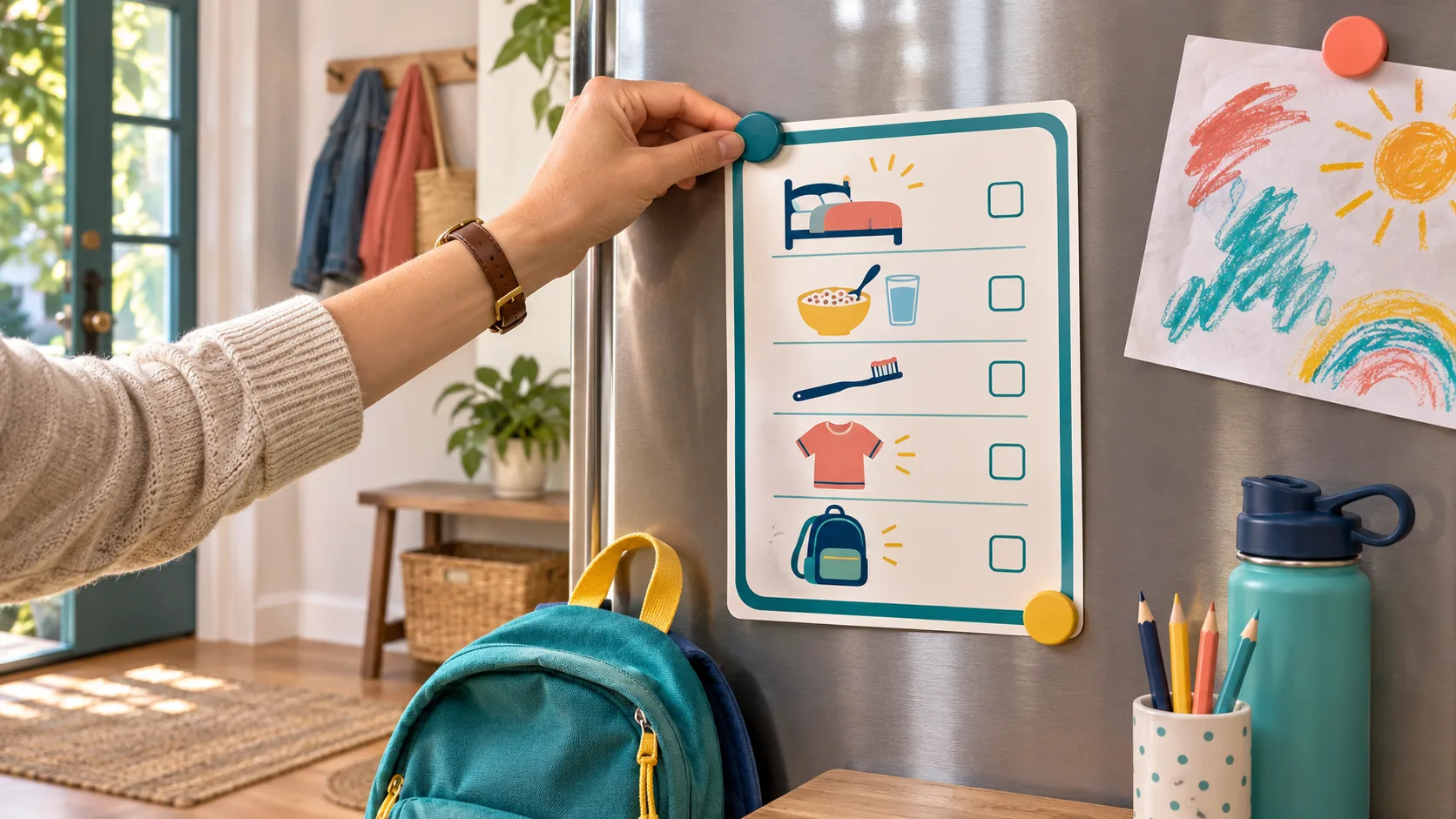
The short version: welcome first, meet a basic need, offer one small choice, create a little quiet, and name what comes next. The goal is not perfect cooperation. The goal is a more understandable next step.
Why a small routine can help
A child may move through several demanding transitions in one day. They leave school, switch caregivers, stop a game, enter a noisy kitchen, begin homework, or hear that it is time to get ready for bed. Adults are making transitions too, often while carrying their own unfinished tasks. When everyone is tired, even a simple request can feel like one demand too many.
A short routine lowers the amount of language and decision-making required in the moment. Instead of inventing a new response every time, you can return to a familiar sequence. Familiar does not mean rigid. It means the child can recognize the shape of what is happening and the adult can spend more energy noticing what support is needed today.
Think of the card as a handrail, not a scorecard. Some days you will use all five steps. On other days you may only welcome your child, offer water, and skip directly to rest. The routine is successful when it makes the next moment a little more manageable.
How to use the printable card
- Choose one location. Put the card where the transition actually happens: near the entryway, on the refrigerator, beside the art supplies, or in a backpack.
- Preview it when everyone is calm. Explain that the pictures are reminders, not rules. Let your child choose a magnet, point to the steps, or suggest a change.
- Use fewer words during the transition. Point to the next step and offer a short sentence. A visual cue can be easier to process than a long explanation.
- Keep the activity genuinely small. Ten quiet minutes can be enough. Do not turn the reset into a hidden homework block or a test of attention.
- Review after a few days. Notice which step helps, where the routine gets stuck, and what can be removed. A useful routine becomes simpler over time.
A calmer next step
1. Welcome
Say hello. Offer water. Ask: “Do you want quiet or company?”
2. Choose
Pick one small activity: draw, color, build, read, or stretch.
3. Focus
Make room for ten quiet minutes. No need to finish.
4. Connect
Ask: “What did you notice?” A word, gesture, or silence is enough.
5. Continue
Name the next step in one calm sentence.
What each step is really doing
1. Welcome: reconnect before directing
A greeting is not a demand. It gives the child a moment to arrive and gives you information about their state. If they need quiet, keep the first interaction warm and brief. If they want to tell you everything at once, listen for a minute before adding the next instruction.
2. Choose: reduce the starting effort
Two options are usually enough. “Draw or build?” is easier to answer than “What do you want to do?” and easier to follow through on than offering an entire shelf of materials. If choosing feels hard, choose for the child and say, “I’ll set this out. You can join when you are ready.”
3. Focus: create a low-pressure landing
The focus step is not about producing something. It can be coloring one section, looking through a book, building a small structure, doing a puzzle, or sitting with music. Keep the environment simple: fewer materials, a comfortable place to sit, and no requirement to finish.
4. Connect: invite without interrogating
One curious question is enough. Try “What did you notice?”, “What should we change?”, or “Do you want me to look or help?” Children can answer with words, pointing, movement, a drawing, or no answer yet. Connection is the invitation, not the quality of the response.
5. Continue: make the next demand predictable
Transitions are easier when the next step is named before it arrives. Use one concrete sentence: “After this, we will put the crayons away and wash hands.” Avoid stacking several future instructions together. One next step leaves room to adjust.
Adapt the routine to the moment
The same five words can support different needs. The routine should change with the child, not force the child to match a fixed script.
- If your child is hungry: move water and a familiar snack into step one. Save questions for later.
- If your child is overstimulated: dim the room, reduce noise, and offer quiet or movement instead of a table activity.
- If your child wants connection: sit close, read together, or make something side by side. The activity can be the conversation.
- If your child is eager to move: try stretching, carrying books, a short walk, or an action song before asking for seated focus.
- If the day is already late: use only welcome, one basic need, and the next step. A shorter routine is still a routine.
Common ways the reset gets stuck
Too many choices
More choices can sound generous but feel like work. Put out two options and keep the rest out of sight. You can change the two options tomorrow without explaining every possibility today.
The adult is trying to make the child productive
A coloring page or building activity can support learning, but the reset is not successful only when something is completed. Rest, regulation, play, and shared attention are worthwhile outcomes too.
The routine is introduced during a meltdown
Teach the card when the child is calm. During a difficult moment, use the fewest words possible and focus on safety and regulation. You can return to the visual routine later.
The card becomes another demand
If pointing to the card creates an argument, pause. Offer a choice without insisting that the child perform the routine in order. The visual should reduce pressure, not add a new way to be “right.”
A gentle one-week experiment
Try the routine at the same transition for five days. Keep the language and location consistent, but let the small activity change. Each day, notice one thing: when did your child begin to settle, which choice was easiest, or what made the next step clearer?
At the end of the week, keep one helpful step and remove one unnecessary step. If the routine is still too much, make it a three-step version: welcome, meet a need, and name what comes next. The best routine is one your family can actually repeat.
Need more ideas for the moment you have?
Use the activity finder to match an age, a need, and the time available, or read the after-school guide for a longer transition plan.
Find an activity Read the after-school guideThis is a general family activity tool, not medical, developmental, or therapeutic advice. Adapt it to your child and circumstances.