Retrieval practice for children: help kids remember without tests
Retrieval practice means asking a child to bring an idea back from memory before showing it again. It can be as simple as “What do you remember about this picture?”—and it works best when it feels like a conversation, not an exam.
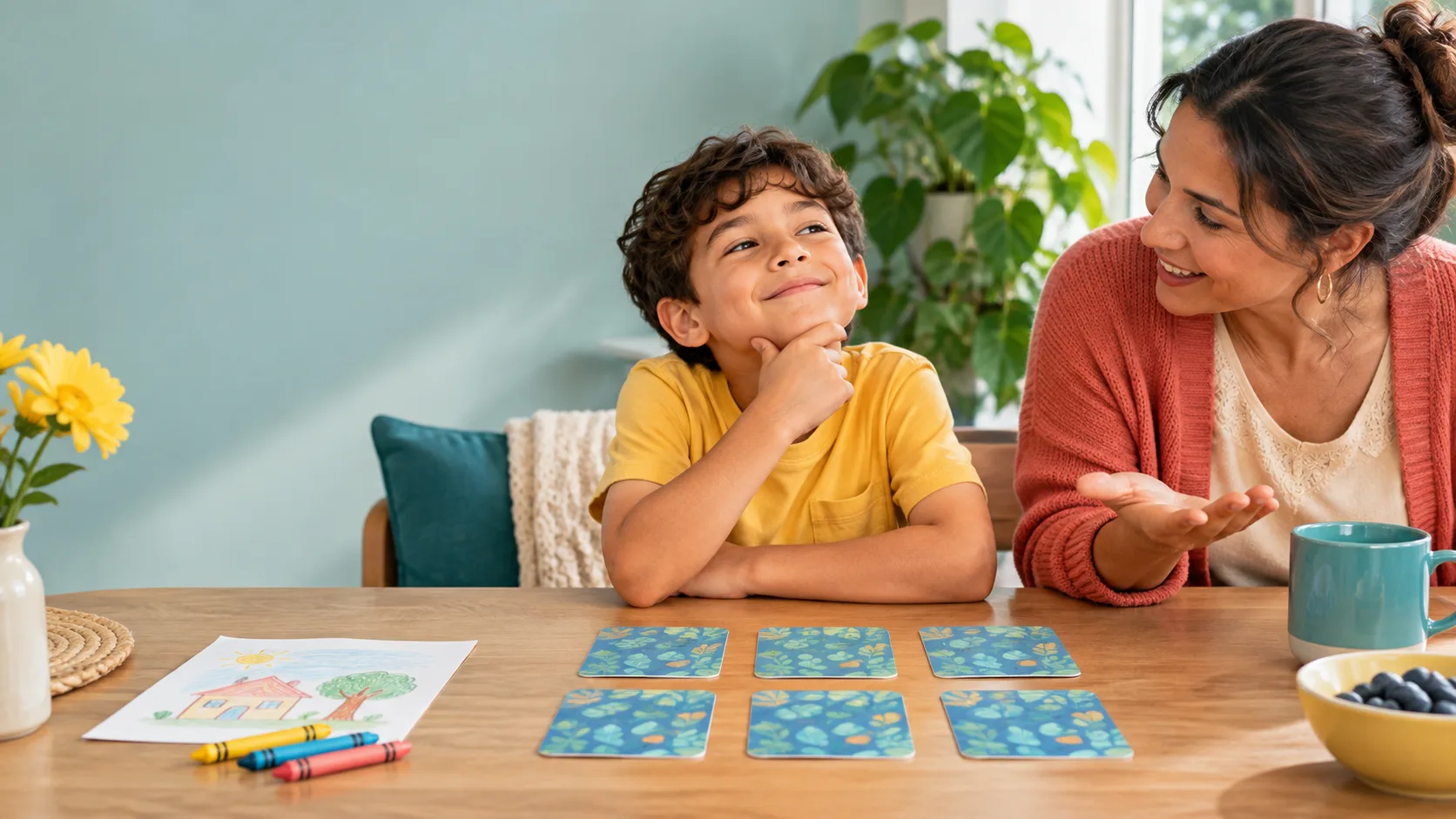
The practical idea: hide the page, ask one easy question, give a hint if needed, then check the answer together.
What is retrieval practice?
Retrieval practice is a learning activity in which the learner tries to recall information instead of only rereading or looking at it. The effort of reconstructing the idea is part of the practice; checking the answer afterward helps correct mistakes.
What the research found
In a Science study, Karpicke and Blunt compared retrieval practice with elaborative concept mapping. Their participants learned more from repeated retrieval on later tests that included comprehension and inference questions.
Research has also examined children directly. One study with primary-school children found positive effects of retrieval-based learning across children with different reading-comprehension and processing-speed profiles.
Read the elementary-school study in PubMed: Retrieval-Based Learning.
Another study with 6- and 7-year-olds compared retrieval practice, repetition, and other approaches for remembering pictures. Retrieval with feedback produced stronger pictorial memory than elaboration at several delays in that experiment.
Read the child pictorial-learning study in PubMed.
How parents can use it at home
Ask before you show
After reading a short story, close the book and ask, “What happened first?” After coloring, cover the page and ask, “What detail do you remember?” Give the child time before offering a clue.
Use pictures, movement, and talk
Retrieval does not have to be written. A child can point, draw, act, sort, explain, or choose between two possibilities. Choose the form that matches the child’s age and energy.
Give feedback gently
After the attempt, reopen the page or offer the answer. Try “Let’s check together” instead of “That’s wrong.” The point is to strengthen memory and understanding, not to measure the child.
A five-minute recall routine
- Look: explore one page, picture, story, or idea together.
- Close: put it away or turn it over.
- Remember: ask one question and wait.
- Hint: offer a first sound, gesture, choice, or related picture if needed.
- Check: look again and celebrate what the child recovered.
Use coloring pages as memory prompts
Choose a page from MyColor.fun. Ask the child to notice three things, then cover it and ask them to name or draw one. Later, revisit the same page and ask what they remember before adding a new related page.
What not to overclaim
Retrieval practice is not a guarantee that every child will remember every fact, and a difficult recall attempt is not proof of failure. Research studies use particular materials, ages, delays, and tests. For family life, use retrieval as a brief, supportive invitation—and stop when it becomes frustrating.
Pair retrieval with spacing
Return to the same idea across several days for a stronger, calmer learning routine.
Read about the spacing effect